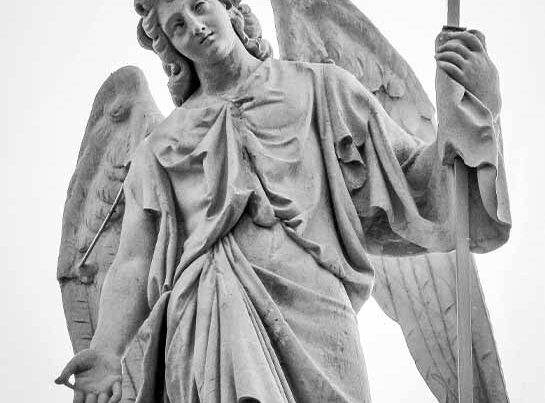
For by him were all things created, that are in heaven, and that are in earth, visible and invisible, whether they be thrones, or dominions, or principalities, or powers: all things were created by him, and for him. (Colossians 1:16)
GOD’S ORGANIZATION
God has organized His angels in a special order. The Bible does not reveal the details of that order, but it does indicate a specific organization:
The organization of the invisible world is described in terms of thrones, dominions, principalities, and powers. We are not given details of this structure. The emphasis is that God created all things in Heaven and on earth and that He is sovereign over these divisions. After His resurrection, Jesus is confirmed to have “…gone into heaven and is on the right hand of God; angels and authorities and powers being made subject unto him” (1 Peter 3:22).
Satan is an imitator, not an originator. He has organized his demons in a structure like that of God’s forces:
For we wrestle not against flesh and blood, but against principalities, against powers, against the rulers of the darkness of this world, against spiritual wickedness in high places. (Ephesians 6:12)
Satan has organized his forces into:
Principalities: A principality is the territory or jurisdiction of a prince. Satan has placed a prince over each principality. The prince of the power of Persia is mentioned in Daniel. This is how Satan works on a national level influencing governments and nations.
Powers and rulers of darkness of this world: These are two categories of demons at work in the social, political, and cultural systems of the world.
Spiritual wickedness in high places: High places in the Old Testament were where worship was carried on. This is how Satan works in the religious structures of the world.
God’s good angels aid Believers in the battle against evil spiritual forces, a subject dealt with later in this study.
CATEGORIES OF ANGELS
As we studied earlier, angels sometimes function in large companies (Psalms 68:17; Matthew 26:53) and they are innumerable (Hebrews 12:22). There are literally multitudes of angels (Luke 2:13-15) who are apparently classified according to the duties they perform. Let’s look at some of these classifications.
The word “archangel” is mentioned twice in Scripture. The Greek word is archaggelos which is a combination of archo (meaning “first” in political rank or power) and aggelos (meaning “messenger”). An archangel is the highest ranked angel and leader of the angels. It denotes a definite distinction of rank for a special service.
The only archangel mentioned by name in the Bible is Michael (Jude 1:9). One other Scripture mentions an archangel in reference to the coming of Christ: “For the Lord himself shall descend from heaven with a shout, with the voice of the archangel, and with the trump of God: and the dead in Christ shall rise first” (1 Thessalonians 4:16).
The Scriptures are not clear as to whether or not there are other archangels in addition to Michael or whether or not he is the archangel who announces the return of Christ.
Cherubs are one of the most commonly depicted types of angels in art, often portrayed as cute, chubby babies with wings. This portrayal is only an invention of artists, as they actually are beautiful and powerful beings. The cherubim are the angels closest to God, serving directly under Him rather than being messengers to mankind.
According to Genesis, a cherub was assigned to guard the tree of life after Adam and Eve were excluded from the garden because of sin (Genesis 3:24). He was stationed there with a flaming sword so that man could not intrude into God’s presence, partake of the tree of life, and live forever in their sinful state.
There were two golden images of cherubim placed on the ark (Exodus 25:18-22). It was here that God manifested Himself on earth in Old Testament times and where His visible glory rested (1 Samuel 4:4; Psalm 80:1). One cherubim was placed at each end of the mercy-seat, with wings stretched upward. They faced each other and looked down toward the mercy-seat, symbolic of viewing the blood that was sprinkled there by the High Priest, representative of the blood that would someday be shed for all mankind by the Lord Jesus Christ. The cherubim were also prominent in Solomon’s temple and Ezekiel’s vision (1 Kings 6:23-29; Ezekiel 41:17).
Ezekiel 1:5–11 gives a more detailed description of these angels. In Ezekiel’s vision, he saw cherubim as living creatures next to the throne of God, worshipping and serving Him. The cherubim had four faces: That of a man, a lion, an ox and an eagle (although Ezekiel 10:14 replaces the face of the ox with the face of a cherub).
Each living creature possessed four wings, two of which covered their bodies and two of which extended upward. They traveled on what appeared to be a “wheel in the middle of a wheel” and went in any direction with great speed like a flash of lightning (Ezekiel 1:16). Their appearance was brilliant like fire and their wings made noise like a great waterfall. The cherubim are frequently called living creatures in these passages. Psalm 80:1 and Psalm 99:1 refer to the Shekinah glory that represents God who is enthroned above the cherubim.
Seraphim, whose name means “fiery ones”, are mentioned in Isaiah 6:2-7. Their name most likely reflects their consuming devotion to God. They are represented as appearing above the King as He sat upon His throne, ready to minister to Him.
They were similar to cherubim, but had six wings. Two wings covered their faces, symbolic of the fact that even sinless creatures cannot look upon a righteous God. Two wings covered their feet, symbolizing their reverence for God. With two wings they flew, representing their readiness to execute God’s orders. From the Seraphim we learn that God is Holy, He must be worshipped with reverence, and we must be prompt to obey His commands.
The Seraphim were crying out, “ Holy, holy, holy is the LORD of hosts; The whole earth is full of His glory!” (Isaiah 6:3). Their proclamation was so powerful that the doors of the throne room shook. They were ablaze with worship of the holy God. Isaiah’s response to this vision was: “Woe is me…I am a man of unclean lips” (Isaiah 6:5). When Isaiah encountered God’s presence and this powerful worship scene, He recognized his own sinfulness.
One of the seraphim touched Isaiah’s lips with a live coal from the altar, and then God gave Isaiah a message for the people of Judah. Only after Isaiah’s lips were cleansed was he ready to deliver God’s message.
- Living Creatures.
This group of angels are mentioned in Ezekiel 1-10 and Revelation 4:6,8; 5:6. Their chief ministry appears to be worship of God (chapters 4,5,7, and 19). They also witness the worship of God by redeemed men (Revelation 14).
The Living Creatures are distinguished from the other angels (Revelation 15:7); they join the elders and the 144,000 in “new songs” (Revelation 5:8, 9; 14:3); and they deliver the commission to those who execute divine judgment (Ezekiel 10:2, 7; Revelation 6 and 15). They are with the Church at the time of the overthrow of her enemies (Revelation 19:4). They are described as having one face, six wings, and with eyes around them and within. Some theologians believe they are Seraphim.
These angels compose the innumerable group seen by Daniel who carry out the will of God in Heaven and earth (Daniel 7:10). They interpret God’s will, protect, provide guidance, bring answers to prayer, announce, warn, instruct, bring judgment, encourage, sustain, deliver, and intercede on behalf of Believers.
“Watchers” are used as a term for angels in only one place in the Bible:
“‘This decision is by the decree of the watchers, and the sentence by the word of the holy ones, in order that the living may know that the Most High rules in the kingdom of men, gives it to whomever He will, and sets over it the lowest of men.’” (Daniel 4:17)
As used in this passage, watchers are apparently angels who observe what is occurring and communicate God’s decree of judgment.
Hosts refers to the military organization of God’s heavenly army. Psalm 46:7 indicates that God has hosts of angels. Second Chronicles 18:18 pictures the Lord sitting on the throne and the host of Heaven standing around Him. Jesus is called the Lord of Hosts repeatedly in the Old Testament and is acknowledged as the creator of the hosts of Heaven:
“You alone are the LORD; You have made heaven, the heaven of heavens, with all their host, the earth and everything on it, the seas and all that is in them, and You preserve them all. The host of heaven worships You.” (Nehemiah 9:6)
SPECIAL GROUPS OF ANGELS
The Bible also mentions special groups of angels in the book of Revelation which are identified by the service they perform:
- Four angels who control the winds: Revelation 7:1
- Seven angels who stand before God: Revelation 8:2
- Seven angels who administer the seven last plagues: Revelation 15:1,7
- The angel of the abyss: Revelation 9:11
- The angel over the fire: Revelation 14:18
- The angel over the waters: Revelation 16:5
NAMED ANGELS
There are two angels mentioned by name in the Bible:
- Michael: His name means “who is like God”. The angel talking with Daniel in chapters 10-12 refers three times to Michael, who is obviously an angel. He calls him “one of the chief princes” in Daniel 10:13; “prince” in Daniel 10:21; and “the great prince” in Daniel 12:1. Michael appears to be assigned to the welfare of Israel, as other angels are assigned to other nations (Daniel 10:13, 20-21).
Michael is described as an archangel in Jude and is mentioned as refusing to bring a slanderous accusation against the devil. In Revelation 12:7, Michael and his angels appear in a battle, implying that Michael is a military leader. Michael commands the hosts of the Lord against the forces of the dragon (Satan) in a war in heaven: “And there was war in heaven: Michael and his angels fought against the dragon; and the dragon fought and his angels, And prevailed not; neither was their place found any more in heaven” (Revelation 12:7-8).
- Gabriel: The meaning of his name is “mighty one of God” or “strong man of God”. Gabriel was the angel sent to Daniel to explain the vision of the ram and the he-goat and to communicate the prediction of the seventy weeks (Daniel 8:16; 9:21-27).
Whenever Gabriel appears in Scripture it is to communicate revelation or interpret God’s plans and purposes regarding the Messiah and the Kingdom. He announced the birth of John the Baptist to Zechariah (Luke 1:11), and the birth of the Messiah to Mary (Luke1:26). He apparently appeared in human form on these occasions, as he spoke with a man’s voice and was able to touch the recipients of his messages.
Gabriel describes himself in the words, “I am Gabriel, who stands in the presence of God” (1:19).
- A Special Angel: There is another angel in Scripture who is called “The Angel of the Lord”. That is the subject later studies on this series of bible study.
YOU ARE NOT ALONE…
In addition to the Trinity of God, there is a mighty group of angels watching over you. You are never alone in your sorrow or your struggles. These messengers of God will be at your side from now through eternity.